The quadrotor configuration — four rotors arranged symmetrically around a central frame — has been the dominant architecture in commercial UAV design for more than a decade, and for good reason. The layout offers a compelling combination of mechanical simplicity, mechanical redundancy in failure-tolerance terms, and flight envelope characteristics that suit the low-to-medium-speed operational profiles typical of inspection and survey missions. But the quadrotor of 2024 is a substantially more capable aircraft than its 2014 ancestors, and the engineering advances responsible for that improvement deserve a detailed examination.
Much of the progress in quadrotor performance has come not from revolutionary new concepts but from systematic refinement of the core design parameters that govern how efficiently the airframe converts motor torque into useful thrust, how accurately the flight controller maintains commanded attitude and position, and how effectively the structure isolates precision sensors from the vibrational environment generated by spinning rotors and propellers. Each of these parameters directly affects the quality of data that a drone-based inspection or survey system can collect, making structural and control engineering choices as important to mission success as sensor selection.
Frame Geometry and Motor Placement
The arm length — the distance from the center of the airframe to each motor mount — is among the most consequential geometric parameters in quadrotor design. Longer arms increase the moment arm available for attitude control, allowing the flight controller to generate larger corrective moments with smaller differential thrust changes across the rotor array. This translates to more precise attitude tracking and better disturbance rejection in wind, at the cost of increased frame size and the aerodynamic interference losses that accompany larger structures.
Industrial UAV designers have converged on arm lengths in the 280mm to 380mm range for platforms in the 2.5kg to 5kg all-up-weight class, representing a pragmatic balance between control authority and structural efficiency. At these dimensions, the aerodynamic interaction between adjacent rotor discs — the leading source of efficiency loss in multi-rotor configurations — can be kept below 8% with careful rotor diameter selection relative to arm length, while still providing adequate moment arm for responsive attitude control in winds up to 10 to 12 meters per second.
Motor cant angle is a more subtle design variable that has received increasing attention in recent years. Tilting each motor outward by a small angle — typically 2 to 6 degrees from vertical — introduces a horizontal thrust component that allows the flight controller to command lateral forces without requiring the full airframe tilt that a conventional quad needs for horizontal acceleration. The result is a more linear relationship between pilot or autopilot command and aircraft response, particularly during low-speed precision maneuvering near structures. The efficiency penalty associated with canted motors is modest at small angles, and the improvement in hover precision around structures justifies the trade for inspection-focused platforms.
Propeller Design for Industrial Applications
Propeller selection is one of the more underappreciated design decisions in industrial UAV development. The naive optimization — maximize thrust per watt of electrical input — is only partially correct for industrial missions. A propeller optimized purely for hover efficiency at low disk loading typically produces its best performance in still air and degrades more significantly than a robustly designed alternative when operating in moderate wind, carrying near-maximum payload, or transitioning between hover and forward flight during corridor inspection.
Industrial applications favor propellers with moderate pitch-to-diameter ratios — typically in the 0.5 to 0.6 range — and stiff, low-flex blade profiles that maintain their geometry under the variable loading conditions of field operations. Carbon fiber composite propellers have largely supplanted injection-molded glass-filled nylon in the industrial segment, offering a combination of high specific stiffness, resistance to impact damage, and low aerodynamic profile drag that translates to measurable efficiency gains at the operating points that matter for extended hover missions.
Propeller balancing is a practical manufacturing and maintenance consideration that has substantial effects on vibration-sensitive sensor payloads. An unbalanced propeller induces a once-per-revolution vibration that propagates through the airframe and couples into inertial measurement units, camera gimbals, and other precision sensors. Quaddro's manufacturing process includes dynamic balancing of all propellers to residual imbalance tolerances of less than 0.1 gram-centimeter — a specification that provides sufficient isolation margin for high-resolution imaging payloads without requiring extremely soft gimbal dampers that compromise pointing stability.
Flight Controller Algorithms and State Estimation
Modern industrial quadrotor flight controllers run attitude estimation algorithms that fuse data from multiple inertial measurement units, GPS receivers, barometric altimeters, and in some configurations optical flow sensors and downward-facing rangefinders. The quality of this sensor fusion directly determines how accurately the vehicle can maintain position and attitude under the full range of environmental conditions it will encounter in service.
Extended Kalman filter (EKF) implementations have been the standard state estimation approach in autopilot systems for most of the commercial UAV era, but the EKF's sensitivity to initialization errors and non-Gaussian noise distributions has led to growing adoption of unscented Kalman filter (UKF) and particle filter alternatives for high-precision applications. Quaddro's QX-series flight controller implements a custom UKF-based estimator that maintains accurate state estimates over a broader range of GPS signal quality conditions than EKF-based alternatives — a meaningful advantage in the urban canyon and near-structure environments common in infrastructure inspection.
Wind estimation is an area of active development in industrial flight controller design. Accurate knowledge of wind velocity allows the controller to apply feedforward compensation to counteract wind disturbances before they cause measurable position deviation, rather than relying entirely on reactive feedback control. Quaddro's flight controller implements a wind estimator that uses the difference between GPS-measured ground velocity and accelerometer-derived body velocity to maintain a running estimate of ambient wind. This estimate feeds into the position controller's disturbance rejection terms, improving position-hold accuracy in moderate wind from the 0.8 to 1.2 meter RMS typical of feedback-only controllers to below 0.4 meter RMS — a difference that is visually noticeable during precision inspection hovering near structures.
Vibration Isolation for Sensor Payloads
The conflict between mechanical stiffness, which is desirable for structural integrity and control responsiveness, and vibration isolation, which is essential for sensor payload performance, is one of the central design tensions in industrial UAV engineering. A structure that is stiff enough to maintain propeller-to-motor shaft alignment under operational loads will efficiently transmit propeller-generated vibration to any sensors mounted on that structure. Resolving this tension requires a deliberate vibration isolation architecture between the propulsion system and the payload mounting interface.
Most industrial UAV designs use a two-stage isolation approach. The first stage isolates the flight controller and IMU cluster from the airframe using soft silicone or viscoelastic mounts tuned to attenuate the frequency range produced by propeller imbalance and harmonic excitation — typically 50 to 200 Hz for rotors in the 3,000 to 6,000 RPM operating range common in commercial drones. The second stage isolates the sensor payload bay from the IMU platform using a separate set of dampers tuned for the sensor's specific mass and sensitivity requirements.
Camera gimbal isolation is particularly demanding because imaging sensors are sensitive to vibration-induced jitter in the sub-millisecond exposure window of each frame. Insufficient isolation at this stage manifests as image blur that cannot be corrected in post-processing, directly degrading the resolution advantage that motivates low-altitude drone surveys in the first place. Quaddro's payload bay uses a dual-axis viscoelastic damper plate that maintains gimbal base motion below 0.5g RMS in the 80 to 400 Hz band during normal powered flight — a specification validated through accelerometer measurement on representative QX-4 airframes during both hover and forward-flight testing.
Structural Materials and Manufacturing
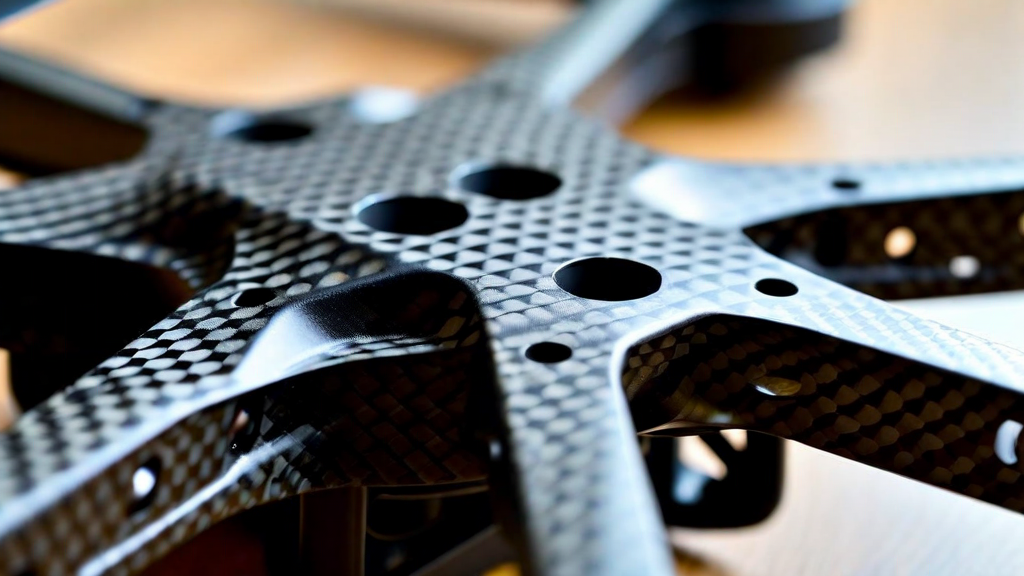
Carbon fiber reinforced polymer (CFRP) has become the structural material of choice for industrial UAV arms and frame plates, offering stiffness-to-weight ratios roughly five times higher than aluminum at comparable cost in production quantities. The manufacturing approach — typically compression-molded or pultruded tubes for arms, and wet-layup or prepreg-cured plates for the central frame — introduces its own design constraints around joint design and fastener selection, since CFRP is notch-sensitive and exhibits relatively poor bearing strength compared to metals.
Hybrid approaches that use CFRP arms and tubes attached to machined aluminum hubs and motor mounts have become standard in professional-grade designs because they optimize each material for its highest-value application. The hub serves as the structural node that distributes loads between arms and accommodates the geometric tolerances required for secure propeller and motor mounting; machined aluminum is well-suited to this role. The arms function primarily as beams in bending and torsion; here CFRP's directional stiffness properties can be exploited to maximize weight-specific rigidity.
Key Takeaways
- Arm length and motor placement geometry directly determine attitude control authority and disturbance rejection capability in industrial quadrotors.
- Propeller stiffness, balance quality, and pitch-to-diameter ratio significantly affect both hover efficiency and vibration transmission to sensor payloads.
- Unscented Kalman filter state estimators outperform standard EKF implementations under GPS-degraded conditions common in infrastructure inspection environments.
- Wind estimation feeding into position controller feedforward terms reduces hover position error by 50–60% compared to feedback-only control in moderate wind.
- Two-stage vibration isolation — separating IMU isolation from payload isolation — is essential for maintaining imaging sensor performance on industrial airframes.
- Hybrid CFRP-aluminum construction optimizes structural material allocation: CFRP for beams, aluminum for load-distribution hubs and motor mounts.
Conclusion
The engineering advances described here are not independent improvements but an integrated set of design decisions that reinforce each other across the stability and sensor performance dimensions that define mission capability. A precisely balanced propeller contributes nothing to data quality if the payload is not adequately isolated from the airframe. Excellent vibration isolation is wasted if the flight controller cannot maintain accurate position in field conditions. Industrial UAV design at the quality level required for enterprise deployment requires systematic attention to every element in this chain.
The field continues to evolve. Adaptive control algorithms that adjust flight controller gains in real time based on estimated wind conditions and payload state represent the near-term frontier for stability improvement. Advanced composite manufacturing techniques are reducing the variability in structural stiffness between individual airframe units — improving the fidelity with which flight controller parameters calibrated in the lab transfer to individual production aircraft. Each of these advances moves the performance bar for what industrial drone operations can reliably deliver.